

See where your prospects stop, and what gets replies.
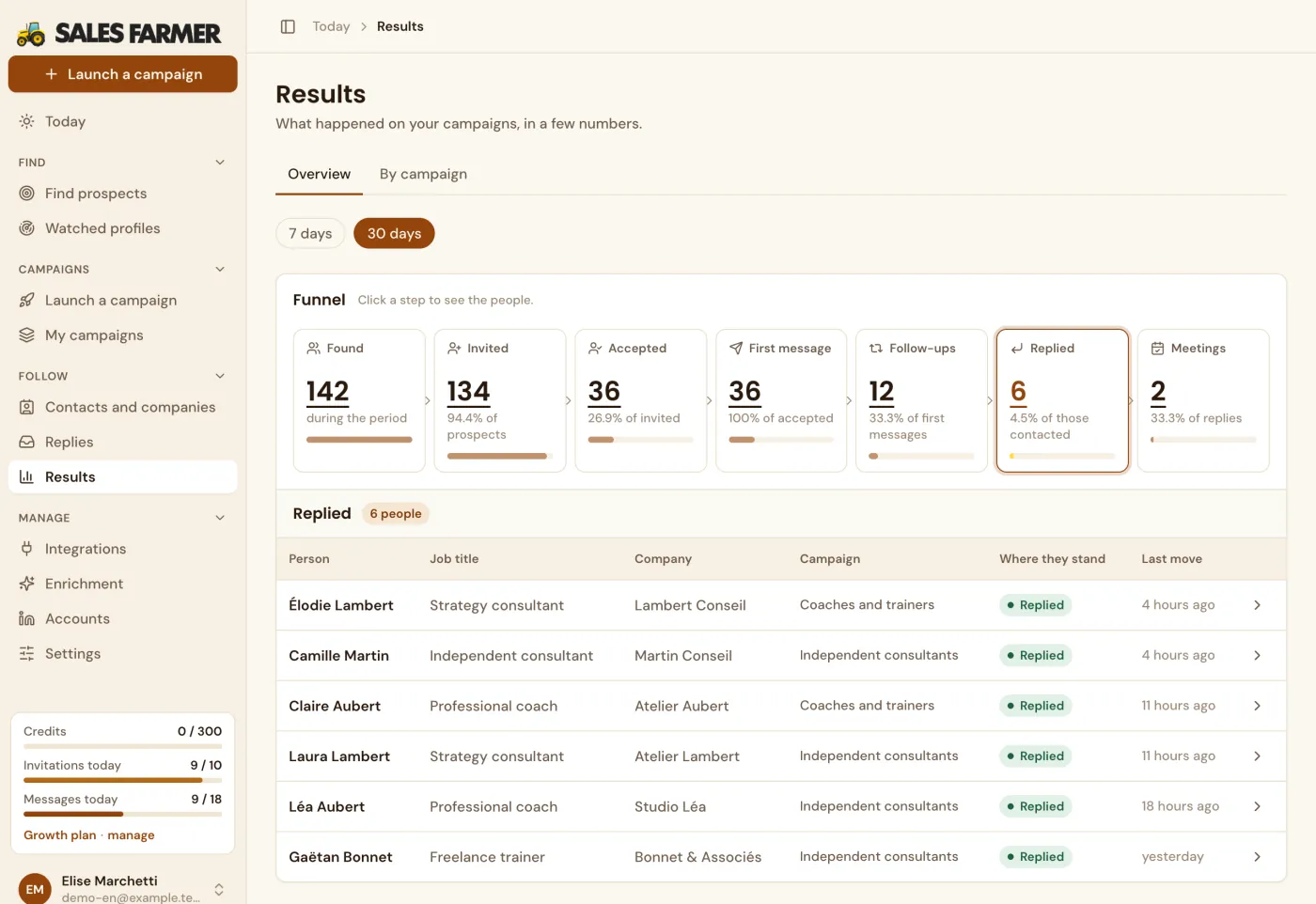
For each campaign, a funnel by step: how many accept, how many reply, how many book a meeting. "What works for you" compares your reasons to write (liked post, commented post, job change), with no percentage before 20 invitations per angle.


 250+ users
How do you measure a LinkedIn campaign?
Look at where people drop off: prospects found, invited, accepted, messages sent, replies, meetings. Sales Farmer shows each step with its rate and says what it is calculated on. One click on a number opens the list of people. A weekly email report is available if you turn it on.
Updated
Acceptance rate
Invites accepted out of invites sent. It tells you how good your targeting is.
Reply rate
Replies out of total leads. It tells you how good your message is.
The people behind the numbers
Click a number to see who accepted and who replied, with their LinkedIn profile.
What people actually reply.
89% reply rate over one week of messages sent with this method, early October 2026.
I saw your post about your SEO articles, it's a change from the usual posts on here.
Between two assignments, do you handle finding new clients on LinkedIn yourself?
J'essaie de me démarquer, avec ma vie un peu atypique haha.
Oui, car je veux faire du sur-mesure 😊In English: Hi, I'm trying to stand out, with my slightly atypical life haha. Yes, because I want to do things tailor-made 😊
I saw that you support executives through their transformations, rolling out AI solutions along the way.
Between two assignments, do you handle finding new clients on LinkedIn yourself?
Yes, exactement !In English: Hi, yes, exactly!
I saw you reacted to the post about managing sales development remotely.
Between two assignments, do you handle your LinkedIn prospecting yourself?
Oui, complètement ! Je me suis lancée récemment donc pour l'instant je gère moi-même toute ma prospection, LinkedIn mais aussi téléphone.
Et justement, je suis en pleine montée en compétences sur la partie Business Development, donc je teste, j'apprends et j'affine ma méthode au fur et à mesure 😅
Qu'est-ce qui t'a fait poser la question ?In English: Hi, yes, completely! I only started recently, so for now I handle all my prospecting myself, LinkedIn but also phone. And I'm in the middle of building my business development skills, so I test, I learn and I refine my method as I go 😅 What made you ask?
I saw that you handle all the prospecting for your clients, from targeting to the booked meeting.
Between two assignments, do you handle your LinkedIn follow-ups yourself, by hand?
Je ne fais que de la prise de rendez-vous par téléphone,
je n'utilise que pour trouver les cibles sur LinkedIn
Donc à la main généralement en recherche cibléeIn English: Hello, I only book meetings by phone, I only use it to find targets on LinkedIn. So by hand, usually, with a targeted search.
Real conversations, names removed. These messages were written and sent by the founder of Sales Farmer, using the tool's method: Sales Farmer prepares and measures, you decide. Here, a reply means any reply from the person, not a meeting. No result is guaranteed.
Paste your website address. Sign-up picks it up for you.
Test your openers, on your own prospects.
Out of 20 to 90 people you tick, the AI writes two or three openers with different angles, each from a real fact about the person. Each person gets only one.
- Three angles: react to what the person did, what takes most of their time, how they do it.
- For each test: people, invitations, accepted, replies, and a reply rate per opener with its margin of uncertainty. A chart follows the cumulative rate, day by day.
- A summary by angle and by heat level across all your tests, and the share of your first messages from the last 30 days that were in a test.
- No percentage before 20 invitations per opener, and no winner on a small gap: the verdict says "too early to tell" or "no clear difference" as long as it has to.
- With Growth: keep the opener that stands out, which you can undo, and "Run another test". CSV export with no personal data, and a line on Today when a test is running.
Limits and risks
- Under 20 people, a rate says almost nothing: the tool flags it instead of drawing a conclusion.
- An openers test needs 20 to 90 people ticked: below that, a gap would mean nothing.
- The test is read on LinkedIn: replies received by email are not counted.
- Records from before October 7 have no date: a test that contains some has no curve, and those first messages do not count in the tested share.
- A person's heat level was not recorded before: older tests have no comparison by level.
- Blog benchmarks come from tool vendors and their customer bases. They are not neutral panels.
Ask your question, John answers
Which numbers do you track for each campaign?
The acceptance rate and the reply rate, campaign by campaign, along with the meetings booked.
Where do I see where people drop off?
On the Results page: the funnel runs from the person found to the meeting.
Do I need a credit card to try it?
No. The trial lasts 14 days and asks for no credit card.